George Town Lanes On Foot: A Walk From Pitt Street To The Clan Jetties
The first thing that hits you at the corner of Pitt Street and Chulia Street is the call to prayer drifting from Kapitan Keling Mosque, its white minaret...
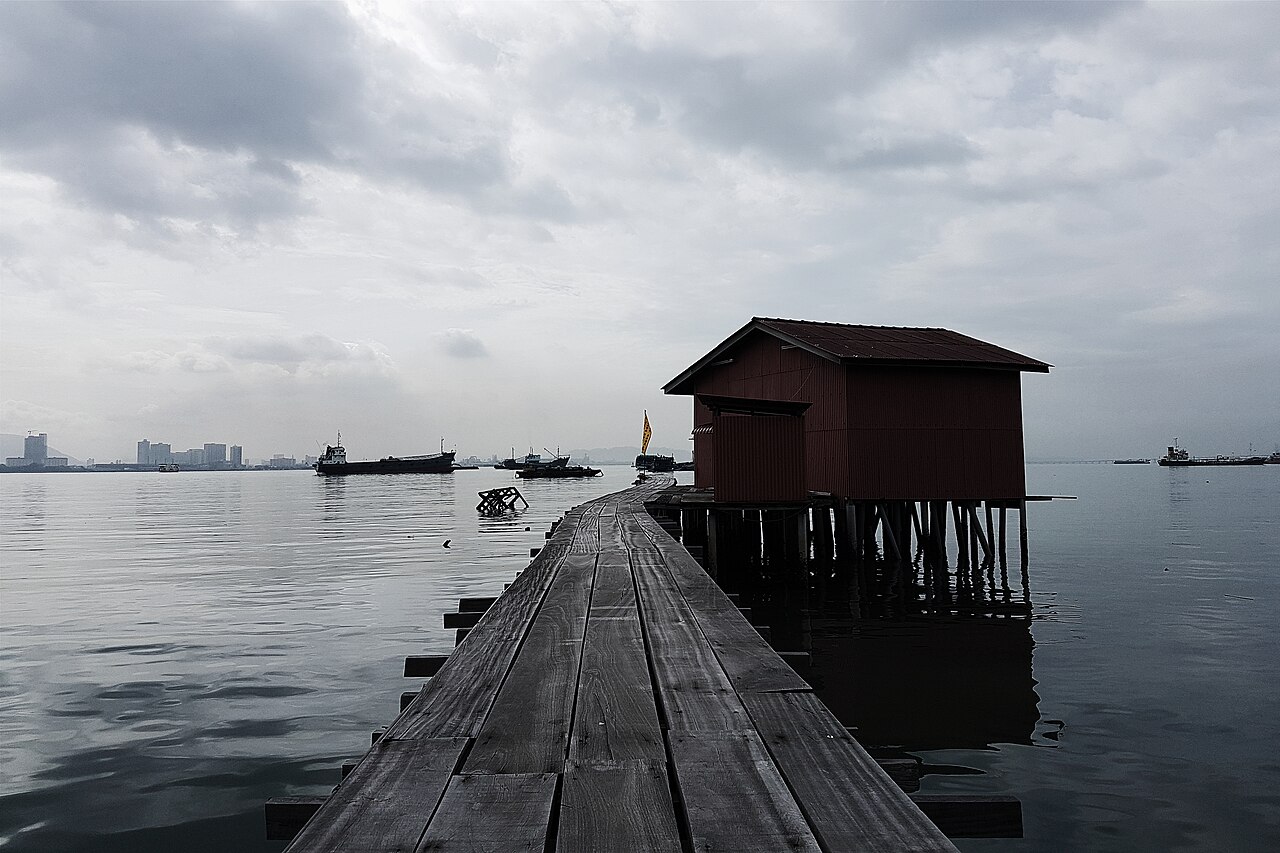
Photo: Lxphotography / Wikimedia Commons, CC BY-SA 4.0 (source)
The first thing that hits you at the corner of Pitt Street and Chulia Street is the call to prayer drifting from Kapitan Keling Mosque, its white minaret rising above the shophouse roofs. The sound arrives mid-morning, around 9:30 or 10 a.m., when the lane is still cool enough for walking.
You will hear it long before you see the mosque itself, because the streets here bend and narrow in ways that hide their landmarks until the last moment. That is the first lesson of George Town: the lanes do not reveal themselves all at once.
We start at the junction outside the mosque, where Jalan Masjid Kapitan Keling meets Lebuh Buckingham. This walk covers roughly three and a half kilometres of flat, shaded lanes, and it takes most people between two and a half and four hours, depending on how often you stop for coffee or stand in front of a mural.
The route runs south from Pitt Street, cuts east through Armenian Street and Ah Quee Street, then turns toward the waterfront at the Clan Jetties. You will pass through the core of the UNESCO World Heritage Site, which covers 109.38 hectares with a 150.04-hectare buffer zone.
George Town was inscribed as a UNESCO World Heritage Site on July 7, 2008, under the category "Melaka and George Town, Historic Cities of the Straits of Malacca." The listing recognises a trading port shaped by Malay, Chinese, Indian and European communities, and the lanes are where that mix is most visible.
A shophouse with Cantonese timber shutters sits beside a Tamil Muslim shrine, and a five-foot way runs beneath both. The five-foot way is the covered walkway that lines most of the old streets, and it is what makes this walk possible even in the afternoon heat.
You should wear shoes that can handle damp concrete and uneven flagstones, because the five-foot ways change height at every threshold. Carry a small bottle of water, but do not worry about food: the route passes more kopitiams and hawker stalls than you could visit in a day.
The walk works best if you start by 8:30 a.m., when the light is soft on the pastel shophouse facades and the lanes have not yet filled with scooters. By noon the same streets feel different: louder, brighter, more transactional.
The Mosque And The Street Of Many Faiths
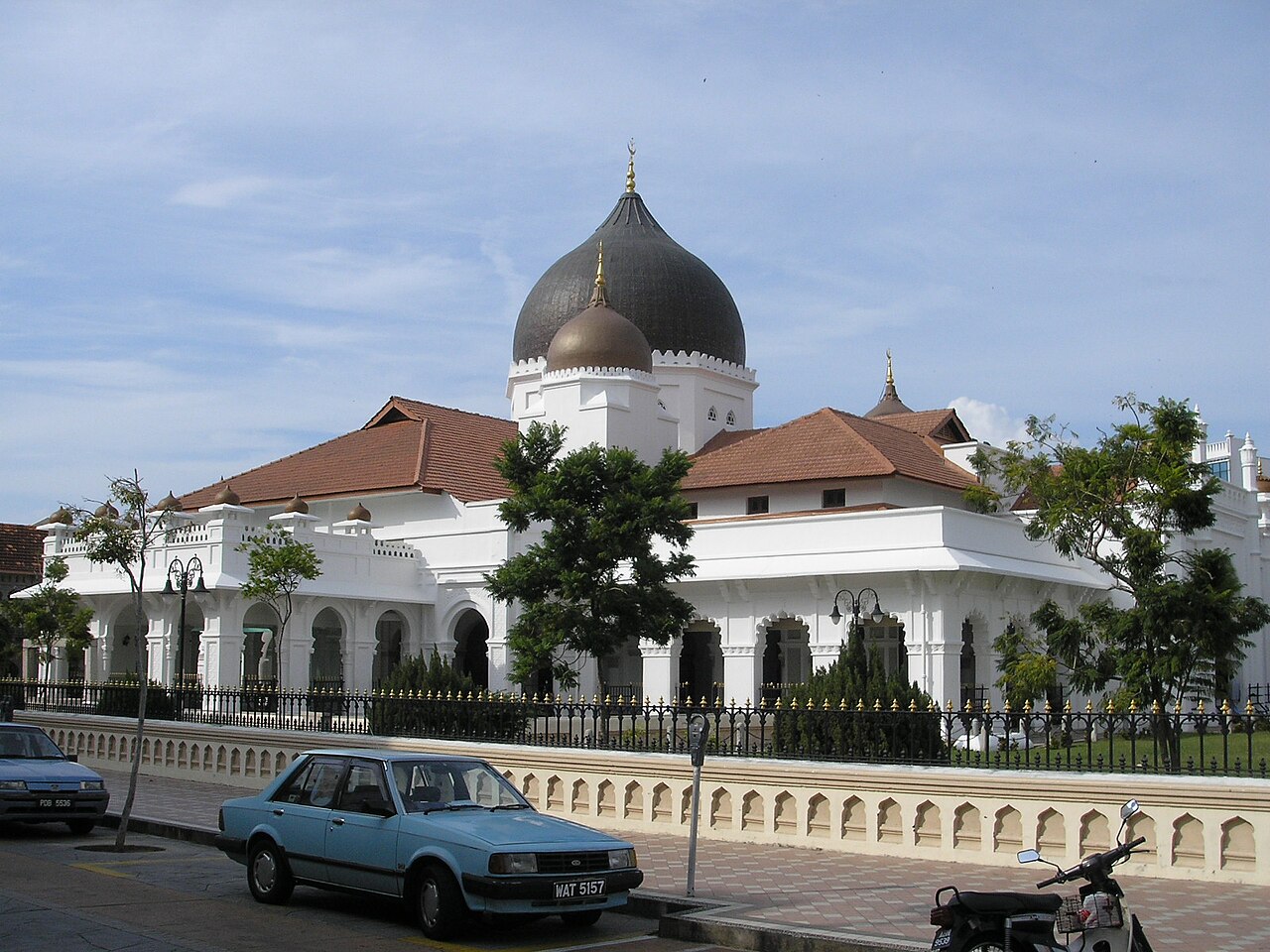
Photo: Gryffindor / Wikimedia Commons, Public domain (source)
Kapitan Keling Mosque was built in 1801, and it sits on a street that carries its name in Malay, Jalan Masjid Kapitan Keling, though older maps and many locals still call it Pitt Street. The building you see today is not the original structure: it was rebuilt and expanded over the nineteenth century, and its current form reflects Indo-Moorish influences with whitewashed walls, horseshoe arches and a single minaret.
The mosque is open to visitors outside prayer times, but you must remove your shoes and dress modestly. Men should wear long trousers, and women are asked to cover their heads and shoulders.
Walk south along Pitt Street and you pass, within a few hundred metres, the Goddess of Mercy Temple, Sri Mahamariamman Temple and St. George's Church. This is sometimes called the Street of Harmony, and the name is not a marketing invention: the buildings are physically that close.
The Goddess of Mercy Temple, also known as Kuan Yin Teng, was founded by Hokkien and Cantonese settlers and remains one of the busiest Chinese temples in Penang. On the first and fifteenth of the lunar month, the courtyard fills with devotees and the air thickens with incense.
The Sri Mahamariamman Temple, built in 1833, has a gopuram, or entrance tower, covered in sculpted figures that catch the morning light. Its carvings were refreshed over the years, and the colours are vivid against the plain shophouse walls around it. St. George's Church, completed in 1818, is the oldest Anglican church in Southeast Asia, a white neoclassical building set behind a lawn.
The juxtaposition is not decorative; it is structural. These communities built their places of worship within sight of one another because the port economy required them to share the same streets.
At the southern end of Pitt Street, turn left onto Lebuh Armenian. The corner is marked by a low wall and a row of parked bicycles, many of them rented by visitors looking for the murals. Armenian Street is named for the Armenian traders who settled here in the early nineteenth century, though few traces of that community remain.
What remains is the street's role as a spine through the heritage core, connecting the temples of Pitt Street to the clan houses and jetties further east.
Armenian Street, Where The Walls Do The Talking
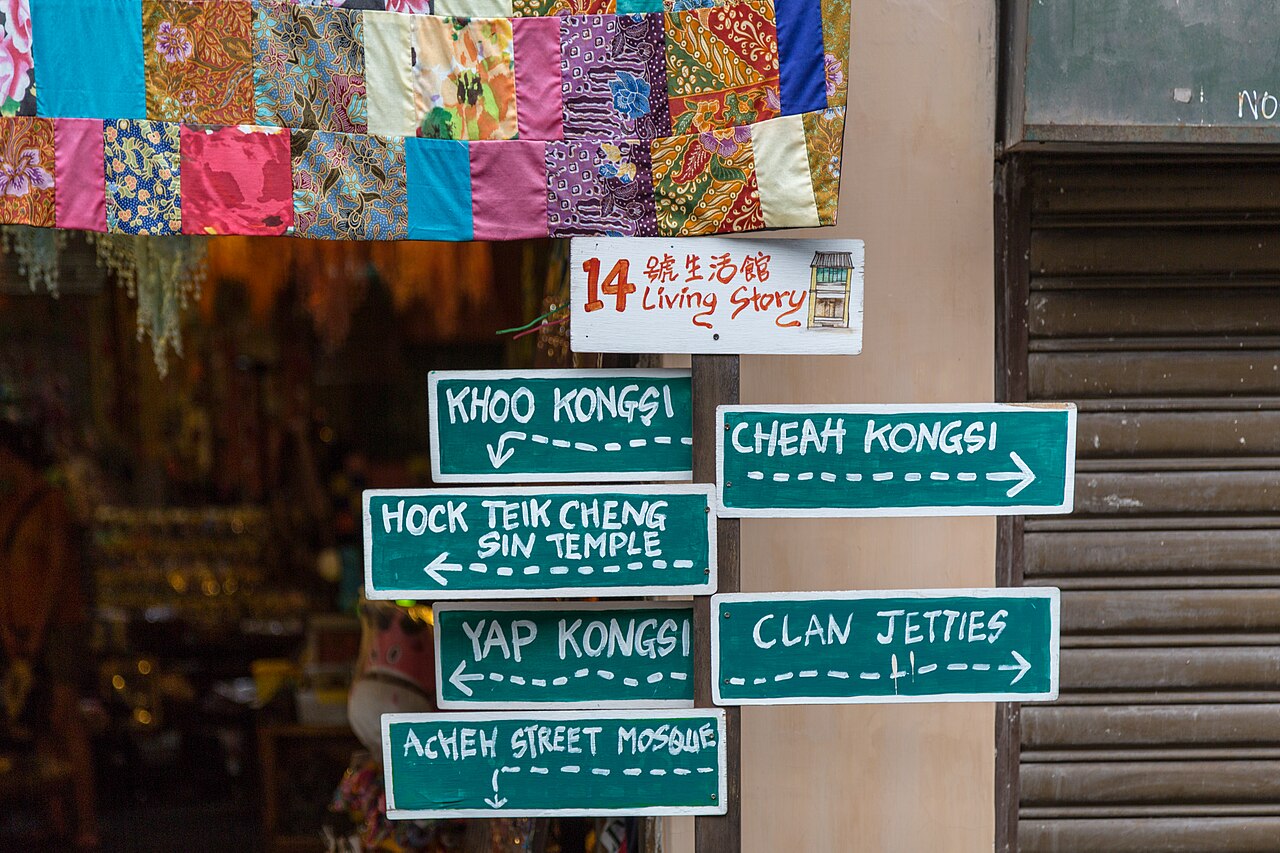
Photo: CEphoto, Uwe Aranas / Wikimedia Commons, CC BY-SA 3.0 (source)
Lebuh Armenian is the lane most visitors come to see, and the reason is the street art. The most famous piece is Ernest Zacharevic's "Children on a Bicycle," painted in 2012 as part of the George Town Festival. It shows two children on a bicycle, and the bicycle itself is a real, rusted metal frame bolted to the wall.
People queue to pose with it, and the queue is shorter before 9 a.m. The mural sits on the side of a shophouse, not in a gallery, and that is the point: the art works because it belongs to the street.
Zacharevic, a Lithuanian artist based in Penang at the time, painted several murals in the same period, and the George Town Festival, first held in 2009, commissioned many of them. The festival runs each year, usually in August, and its walking tours and performances draw attention to lanes that were once purely residential.
The murals have changed the street's economy: souvenir stalls, juice vendors and trishaw drivers now line the route. Some of the older residents have moved out, and the lane is quieter in the early morning than it was a decade ago.
Keep walking east and you reach the junction with Lebuh Cannon, where a second Zacharevic mural, "Boy on a Chair," occupies a corner wall. The chair is real, and the boy painted above it seems to be climbing toward a window. Further along, the "Little Children on a Bicycle" and "Old Motorcycle" pieces continue the same trick of mixing paint with found objects.
The motorcycle mural uses a real Honda cub, its handlebars worn smooth by hands. These works have been restored and touched up over the years, and the paint is thicker now than when they were first applied.
The street art is not the only thing on Armenian Street. The Sun Yat-sen Museum occupies a shophouse where the Chinese revolutionary stayed in 1910, and the building's blue facade is a landmark in its own right. Across the road, a row of goldsmiths and stone carvers still works in shops that have been family-run for generations.
The five-foot way here is uneven, and you will step up and down as you move from one shopfront to the next. That rhythm - step, pause, look, step again - is the rhythm of the lane.
At the end of Armenian Street, where it meets Lebuh Acheh, you will see the entrance to a small lane called Soo Hong Lane. This is where the "Marking George Town" project installed one of its 52 steel-rod caricatures in 2009.
The project, run by George Town World Heritage Incorporated, placed these comic-strip figures at key locations across the heritage zone, each one telling a story about the street it stands on. The caricatures are easy to miss if you are looking at the murals, but they reward a second glance.
Ah Quee Street And The Clan Houses
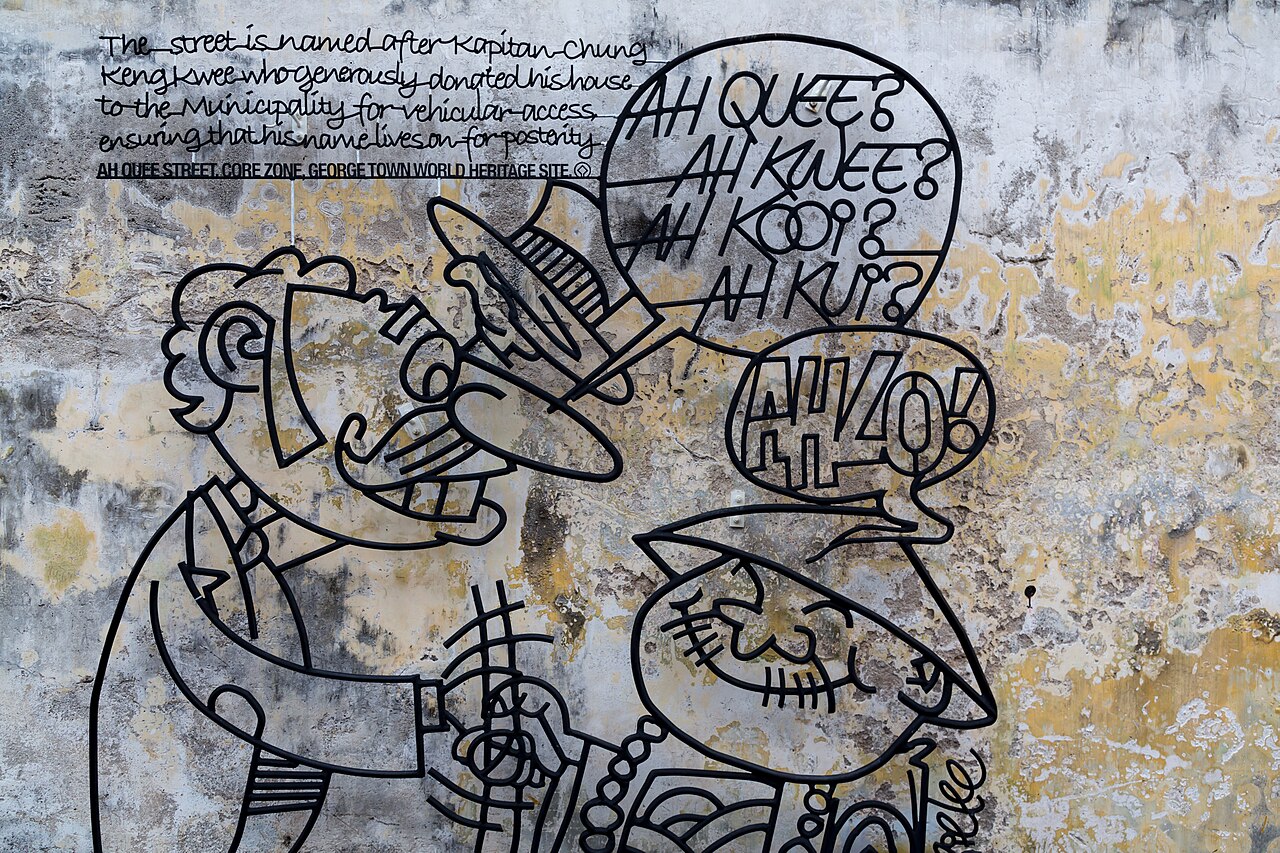
Photo: CEphoto, Uwe Aranas / Wikimedia Commons, CC BY-SA 3.0 (source)
Turn left onto Lebuh Acheh, then right onto Ah Quee Street, which runs south toward the waterfront. Ah Quee Street is narrower than Armenian Street, and its five-foot ways are older, with original clay tiles underfoot. The street is named for a prominent nineteenth-century Chinese merchant, and it was once lined with clan houses and kongsi buildings.
A kongsi is a clan association, and these buildings served as meeting halls, schools and mutual-aid societies for migrants from the same district in China.
The most striking is the Khoo Kongsi, though its entrance is on Cannon Square, a short walk back toward Armenian Street. The Khoo Kongsi is a clan temple built in the late nineteenth century, and its carved beams and painted panels are among the finest in Penang.
The building was damaged by fire in 1901 and rebuilt, and the current structure reflects the wealth of the Khoo clan at the height of the port's prosperity. Admission is charged, and the ticket office keeps shorter hours than the street outside.
Ah Quee Street itself is quieter, and that is its appeal. The shophouses here are mostly two storeys, with timber upper floors and plaster lower walls, and many still have their original air wells. An air well is an open shaft in the centre of the shophouse that draws hot air upward and lets light into the interior.
You can see the principle at work if you stand in a doorway and look up: the roof seems to hover above a column of light. The street is residential in parts, and you will hear radios and the clatter of mahjong tiles through open windows.
The "Marking George Town" project placed one of its steel-rod caricatures on Ah Quee Street, and it is worth stopping to read the plaque. The caricatures were designed by a local artist and installed in 2009, and each one is accompanied by a short text in English, Malay and Chinese.
The texts are specific: they name the trades once practised on that lane, the families who lived there, the festivals held in the street. They turn the lane into a storyboard, and they do it without a tour guide.
From Ah Quee Street, continue south toward Lebuh Pantai, the old Beach Street. This was the financial heart of colonial George Town, and the buildings here are bigger: banks, trading houses and shipping offices in neoclassical and Art Deco styles. The George Town Dispensary, at the corner of Jalan Pantai and Gat Lebuh China, is a good example of the period, with its curved facade and painted signage.
The dispensary building dates from the early twentieth century and now houses a cafe, but the exterior remains largely as it was.
Muntri Street And The Shophouse Revival
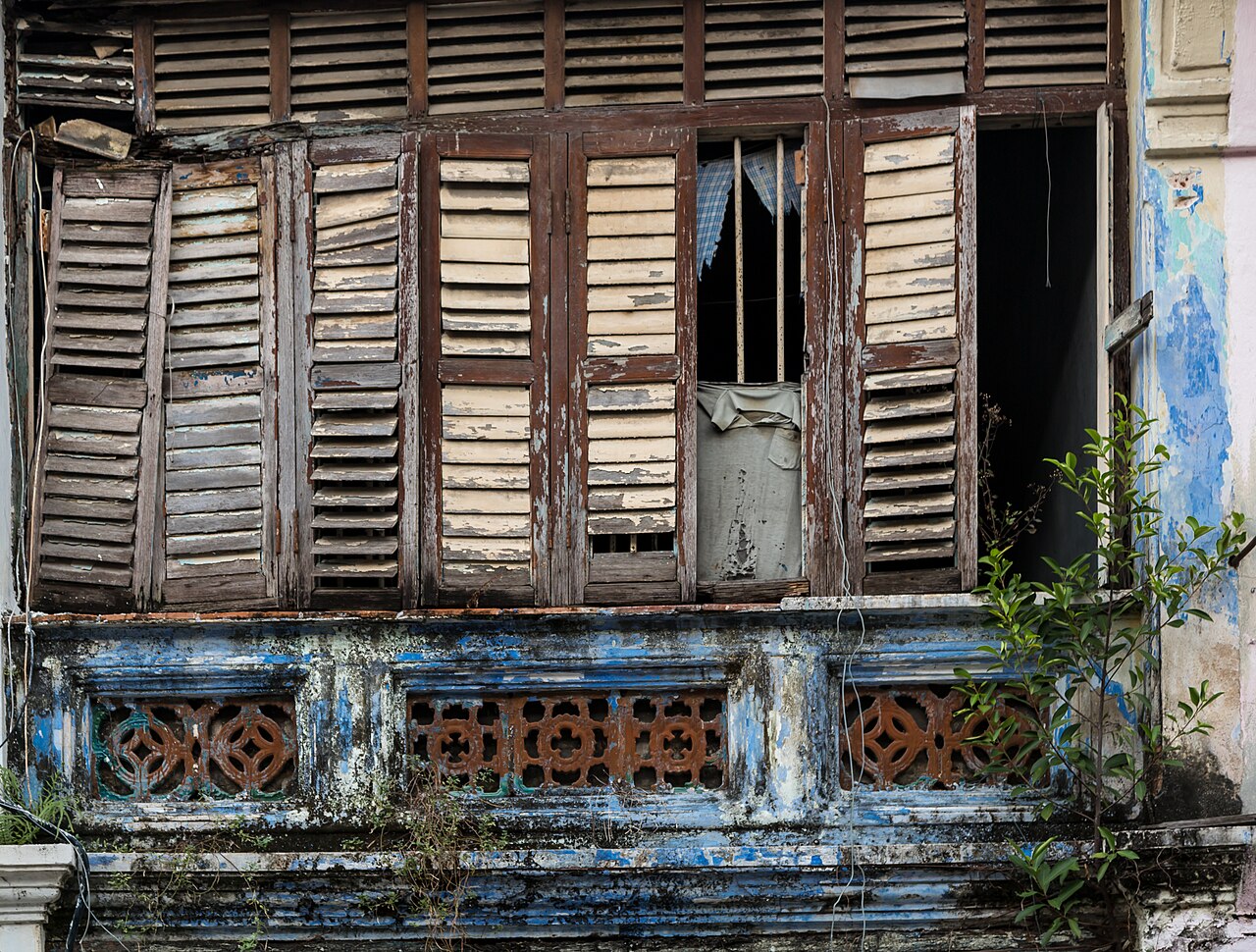
Photo: CEphoto, Uwe Aranas / Wikimedia Commons, CC BY-SA 3.0 (source)
Double back from Beach Street and head west along Lebuh Chulia, then turn onto Muntri Street. Lebuh Muntri is one of the most restored lanes in the heritage zone, and it shows what conservation can do when it is done well. The street is lined with shophouses that have been converted into boutique hotels, cafes and offices, but the conversions have kept the original facades, timber shutters and five-foot ways.
The street feels curated, but it is not a museum: people live and work here.
Muntri Mews, a converted stable block, is now a cafe and guesthouse, and its courtyard is a good place to stop for a coffee or a cold drink. The building was once the mews, or stables, for the mansion on Leith Street, and the original feeding troughs are still visible in the walls.
Seven Terraces, a hotel further along the street, occupies a row of seven shophouses that were restored over several years, and its interiors reference Peranakan design with dark timber and antique tiles. Room rates are not cheap, but you can walk through the lobby and look at the courtyard without staying.
Muntri Street is also a place to see the building types that make up the heritage zone. The shophouse form - narrow frontage, deep plan, air well, five-foot way - is repeated along the lane with variations in detail. Some have Chinese gable ends, others have European pediments, and a few have Malay timber fretwork.
The UNESCO listing notes that the site contains over 1,700 heritage buildings, and Muntri Street holds a good cross-section of them. The mix is not accidental: it reflects the building codes and fashions of different decades.
The street is named for the Muntri, or ministers, of the Acehnese court who once lived in the area, though the Acehnese community has long since dispersed. What remains is the street's association with the Peranakan Chinese, the Straits-born Chinese who blended Malay and Chinese customs.
The Pinang Peranakan Mansion, on nearby Church Street, houses over 1,000 antiques and artifacts of Peranakan culture, and it is worth a visit if you have time. The mansion is a restored nineteenth-century townhouse, and its interiors are dense with carved furniture, porcelain and embroidered textiles.
From Muntri Street, walk north to Leith Street, where the Cheong Fatt Tze Mansion stands. The mansion, also known as the Blue Mansion, was built in the 1880s for a Chinese merchant and is now a hotel and event space. Its indigo-blue walls are the most photographed facade in the area, and the colour comes from a lime wash mixed with natural indigo.
The mansion offers guided tours at set times, and the tour explains the feng shui principles behind the building's layout. Even if you do not go inside, the exterior is worth the detour.
Love Lane And The Lanes Of The Old Vice District
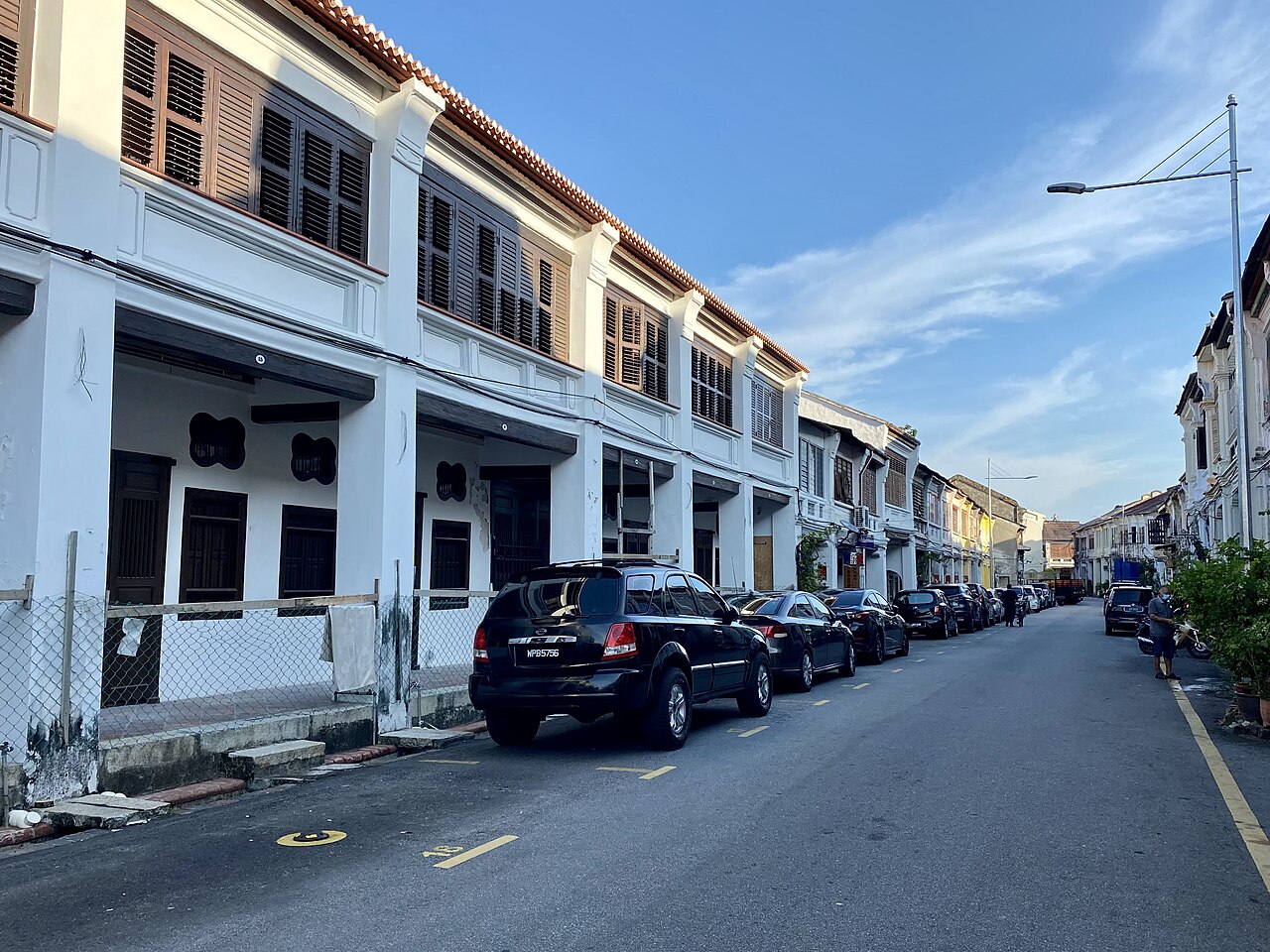
Photo: Slleong / Wikimedia Commons, CC0 (source)
From Leith Street, walk south again toward Love Lane, whose Malay name is Lorong Cinta. Love Lane is a narrow street that runs between Lebuh Chulia and Lebuh Farquhar, and its name has long been the subject of speculation. The Star Online, in a travel feature published on February 27, 2016, described the lane as a place historically associated with Chinese secret societies and later with romantic liaisons.
The feature notes that the name may have come from the wealthy men who kept mistresses in the shophouses here.
The lane today is a mix of budget guesthouses, small bars and cafes, and it fills with backpackers in the evening. By day it is quieter, and you can see the original shophouse facades without the neon and the crowds. The buildings are narrower than those on Muntri Street, and many have wooden staircases visible through open doorways.
The five-foot ways are worn smooth, and the drains run open in places, so watch your step after rain.
Love Lane is part of a network of lanes that once formed the vice district of George Town, an area of brothels, opium dens and gambling houses that operated under colonial regulation. The lanes were dense and difficult to police, and their reputation kept respectable society away. That history is largely invisible now, but the street layout remains: narrow, interconnected, easy to lose your bearings in.
The lane names - Love Lane, Muntri Street, Chulia Street - carry the residue of that past.
The Star Online feature also notes that Love Lane was once home to Chinese secret societies, which used the lane's shophouses as meeting places. These societies, or hui, provided mutual aid and protection for migrants, but they also ran protection rackets and fought turf wars. The lane's association with romance came later, as the societies declined and the area became known for its brothels.
The two histories are tangled, and the lane does not advertise either one.
Walk the length of Love Lane and you emerge on Lebuh Farquhar, where the Eastern & Oriental Hotel stands. The E&O, as it is known, opened in 1885 and was one of the grand hotels of the colonial era, a rival to Raffles in Singapore and the Strand in Rangoon.
The hotel's seafront lawn is open to non-guests, and it is a good place to sit for a few minutes and look back at the lanes you have just walked. The contrast between the hotel's wide corridors and the narrow lanes behind it is the contrast of George Town itself.
The Clan Jetties, Where The City Meets The Water
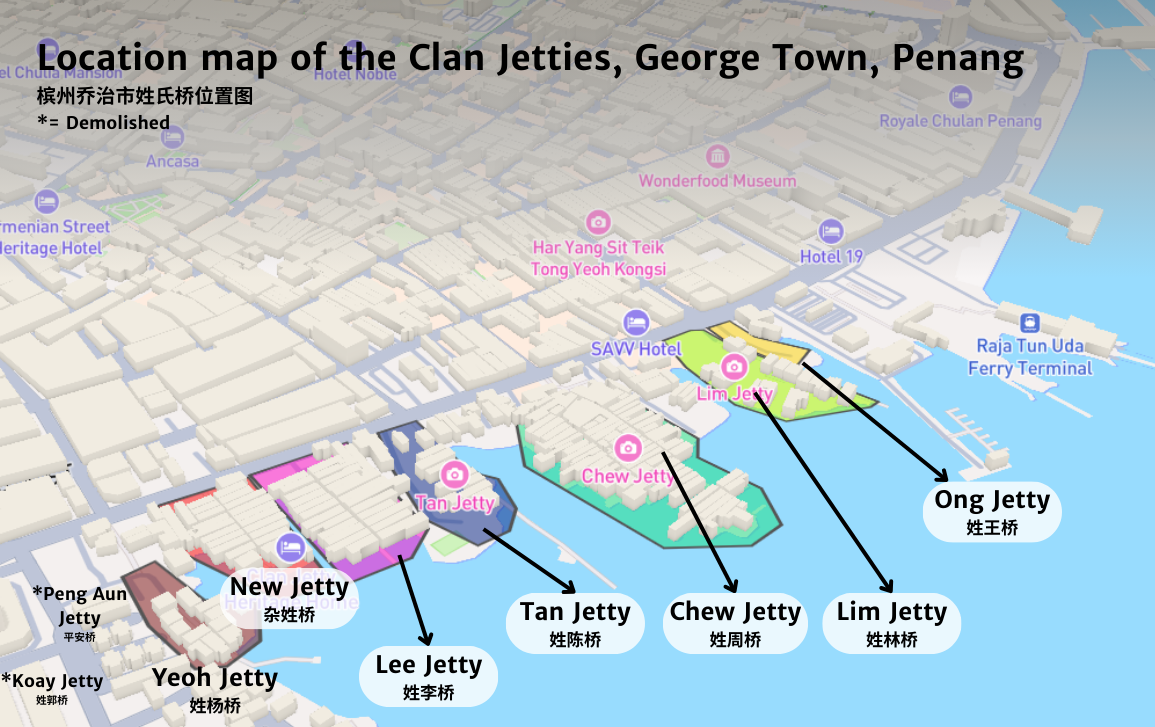
Photo: angys / Wikimedia Commons, CC BY-SA 4.0 (source)
From Lebuh Farquhar, walk east toward the waterfront and the Clan Jetties. The jetties are a row of wooden settlements built on stilts over the water, and they are among the oldest continuously inhabited waterfront communities in Malaysia. Chew Jetty, the largest and most visited, dates back to the mid-nineteenth century, when Chinese migrants from the Chew clan settled here and built their houses on wooden piles.
The jetty is a working neighbourhood, not a museum, and people live in the houses year-round.
The entrance to Chew Jetty is marked by a wooden arch, and the walkway runs straight out over the water. The houses are built of timber, with corrugated iron roofs, and many have been extended and repaired over the decades. The stilts are visible at low tide, and the smell of salt and creosote hangs in the air.
The jetty is busiest in the late afternoon, when tour groups arrive, but in the morning it is quiet enough to hear the water lapping against the piles.
The Clan Jetties are named for the clans that founded them: Chew, Lim, Tan, Lee, Yeoh and others. Each jetty is a separate settlement, with its own temple, its own leadership and its own history. The jetties were built outside the formal city, on land that was not subject to the usual colonial building regulations, and they grew organically as more migrants arrived.
The Chew Jetty Heritage website describes the settlement as a living example of a traditional stilt-house community, and it notes that the jetty has survived fires, storms and redevelopment pressure.
Walking along Chew Jetty, you will pass small shrines, drying fish, potted plants and the occasional cat asleep on a doorstep. The houses are close together, and the walkway is narrow, so you will step aside for residents on bicycles. At the end of the jetty, the view opens onto the Penang Strait, and you can see the ferries and cargo ships moving toward the harbour.
The water is murky close to shore, but the light in the late afternoon turns the whole scene gold.
The jetties are part of the UNESCO buffer zone, and their future has been the subject of debate for years. Some residents have repaired and modernised their houses, while others have left, and the jetties are quieter than they once were. The Chew Jetty Heritage website notes that the community is working to preserve the traditional architecture while adapting to modern needs.
That tension - between preservation and change - is the same tension that runs through every lane on this walk.
The Practical Details
- Start: Kapitan Keling Mosque, Jalan Masjid Kapitan Keling (Pitt Street).
- End: Chew Jetty, Pengkalan Weld.
- Nearest station or stop: The nearest bus terminal is Komtar, about 15 minutes on foot from the start; the free CAT bus stops at Pitt Street and Lebuh Chulia.
- Distance and time: About 3.5 km; allow 2.5 to 4 hours at a slow pace with stops.
- Opening hours: Kapitan Keling Mosque is open to visitors outside prayer times; the Pinang Peranakan Mansion and Cheong Fatt Tze Mansion have set tour times, so check on the day.
- Costs: The walk itself is free. Museum and mansion admissions range from about RM10 to RM25; coffee and food along the route cost roughly RM5 to RM25 per stop.
- Access: The five-foot ways have uneven surfaces and steps; the Clan Jetties walkway is wooden and can be slippery after rain.
Final Words On The Neighbourhood
The thing you notice after walking these lanes is how much of George Town happens in the gaps: the five-foot way, the air well, the narrow passage between two shophouses. The city's history is written not in monuments but in thresholds, in the spaces people share to move, trade and breathe.
Walk the route again in the evening, when the shutters come down and the lanes change character, and you will see it differently. The lanes are not a backdrop; they are the city's real architecture.
Sources
- UNESCO World Heritage Centre - Melaka and George Town
- Chew Jetty Heritage - Clan Jetties of George Town
- George Town Festival - About
- George Town World Heritage Incorporated - Official Site
- Marking George Town - Public Art Project
- Penang Global Tourism - George Town Street Art
- Pinang Peranakan Mansion - Official Website
- The Star Online - Love Lane: A History of Romance and Secrets