The Coffee Machine That Refused To Wait For The Cloud
Ask an engineer who works with factory sensors what finally pushed them toward edge computing, and you rarely hear a theoretical argument. You hear about a pump that should have shut down in two hundred milliseconds but waited eight hundred because the decision had to travel to a data centre three states away. The pump did not wait. The repair bill did.
The promise of the Internet of Things was always a little lopsided. We got very good at generating data and reasonably good at storing it, but the bit in between - the part where a device actually does something useful with the information - often got stuck in a round trip that made no physical sense. A vibration sensor on a turbine knows something is wrong before a human does. Sending that knowledge to a distant server and back again before acting on it is not just inefficient.
It is, in some settings, genuinely dangerous.
The quiet shift happening now is not about replacing the cloud. It is about deciding which decisions cannot afford the journey. Edge computing takes the processing work that used to happen in a centralised data centre and moves it to a device or a small local server sitting much closer to the action. Sometimes that means a computer inside the factory gate. Sometimes it means a chip on the sensor itself. The principle is the same: compute where the data is born, not where it eventually goes to rest.
The Vending Machine That Keeps Its Own Receipts
Most of us have an intuitive model of cloud computing even if we never use the phrase. You snap a photo on your phone, it uploads somewhere, and later you can find it on your laptop. The phone is a thin client; the heavy lifting happens elsewhere. For a thermostat or a fitness tracker, that model works well enough. A few seconds of latency barely register when you are adjusting the heating from your sofa.
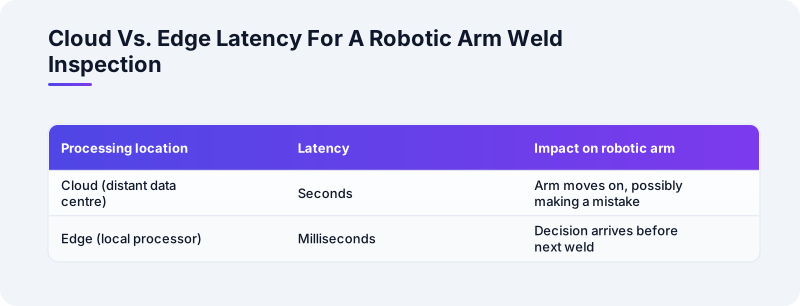
The trouble begins when the thing generating the data needs an answer right now. A robotic arm on an assembly line making hundreds of welds per minute cannot pause while a server in Virginia decides whether the last weld was within tolerance. By the time the answer arrives, the arm has already moved on and possibly made a mistake. Edge computing solves this by putting a small processor right on the factory floor, sometimes inside the robot controller itself, so the inspection decision takes milliseconds rather than seconds.
The cloud still gets a summary later, but it does not get a veto over every weld.
This is not a new idea dressed up in fresh jargon. Industrial controllers have done local processing for decades. What changed is the volume and variety of data, and the realisation that sending everything to the cloud was never going to be cheap or sensible. The IBM Cloud team put it plainly: moving processing closer to the source cuts both latency and bandwidth use. The second part matters almost as much as the first, because IoT devices can be astonishingly chatty.
Nothing Says Forever Like A Hash
There is a less obvious reason to keep data close to home, and it has nothing to do with speed. Every time a sensor reading leaves the local network and travels across the public internet, it passes through infrastructure the device owner does not control. For a soil moisture sensor on a farm, that might not feel like a pressing concern. For a camera counting people in a hospital waiting room, or a microphone listening for equipment faults in a power station, it very much does.
Edge architectures let you process sensitive data locally and send only aggregated or anonymised results to the cloud. A smart camera can count the number of people in a room and transmit the tally without ever sending a video stream off-site. Cisco's guidance on the subject is direct: limiting data exposure and enabling local threat detection improves security in ways that a purely cloud-dependent setup cannot match. The fewer copies of raw data that exist outside the building, the smaller the attack surface.
That does not mean edge devices are magically secure. A cheap sensor left in a field with no physical protection is still a cheap sensor left in a field. But the architectural principle is worth taking seriously. When a breach happens on a centralised cloud server, the exposure can be vast. When it happens on a single edge node, the damage is contained. The trade-off is that you now have many more devices to manage, each one a potential weak point.
Security becomes a question of hygiene across a distributed fleet rather than a fortress around a single data centre.
The Factory That Learned To Think For Itself
Nowhere is the edge argument sharper than in industrial settings, where the phrase "predictive maintenance" has been promising to save money for years and occasionally delivering. A typical setup involves vibration sensors, temperature probes and current monitors attached to motors, pumps and conveyor belts. These sensors generate a steady stream of data, most of it boring, some of it the early signature of a bearing about to fail.
Sending all that raw sensor data to the cloud for analysis is expensive and slow. An edge device can run a machine-learning model locally, trained elsewhere but deployed on a small computer inside the factory, that recognises the vibration pattern of a failing bearing in real time. The O'Reilly guide to AI at the edge describes exactly this pattern: real-time analytics and decision-making happen where the data is created.
The cloud still has a role - it is where the model gets trained on historical data - but the inference, the actual moment of judgment, stays local.
The honest caveat is that running machine-learning models on edge hardware is not trivial. The chips that do it well are still evolving, and the software tooling is fragmented. A model trained on a powerful cloud GPU does not always shrink gracefully to fit a low-power processor bolted to a factory wall. The technology works. The question is whether the engineering effort required to deploy and maintain it is justified for a given use case, and the answer is not always yes.
When The Connection Goes Down And Nothing Stops
A less glamorous but arguably more important benefit of edge computing is what happens when the internet connection does not work. Rural agricultural sensors, offshore oil platforms, mining equipment deep underground - these operate in places where connectivity is intermittent at best. A purely cloud-dependent IoT device in those environments is a paperweight most of the time.
Microsoft's documentation on edge computing makes a point that sounds obvious once you hear it: devices can operate offline and process data locally for faster insights. The word "offline" does a lot of work there. It means a pump controller on a remote water treatment plant can keep making decisions based on local sensor readings even when the satellite link is down. When the connection returns, it synchronises the important bits. The system degrades gracefully rather than failing completely.
This resilience changes the economics of where you can usefully deploy IoT. A vineyard in a valley with patchy mobile coverage can still run a network of soil sensors and weather stations that adjust irrigation valves locally. The cloud gets a daily summary instead of a constant stream, and the vines get watered regardless. The operational cost saving comes not just from reduced data transmission fees but from not needing to build expensive connectivity infrastructure in places where it makes no commercial sense.
The 5G-shaped Piece Of The Puzzle
It is tempting to see edge computing and 5G as a neatly matched pair, and in some respects they are. The ultra-reliable low-latency communication mode that 5G standards define - known to engineers as URLLC - promises round-trip times in the single-digit milliseconds. That is fast enough to make a difference for applications like autonomous vehicles, where a car needs to react to a hazard before the driver's foot has even moved toward the brake pedal.
Qualcomm's research points out that combining 5G's low latency with edge computing unlocks applications that were previously impractical. An autonomous vehicle does not just need fast connectivity. It needs the computing resource that processes incoming sensor data to be physically close, because even light travels too slowly for a round trip to a distant data centre to be acceptable at highway speeds. Putting edge servers at 5G base stations, sometimes called multi-access edge computing, shortens that path dramatically.
The less breathless reality is that 5G coverage is still patchy, and the full URLLC specification is not universally deployed. Many of the most compelling edge computing use cases work perfectly well on existing 4G networks or on local Wi-Fi. The 5G piece is genuinely useful where ultra-low latency and high mobility intersect, but that is a narrower set of scenarios than some marketing would suggest. For a stationary factory robot, a wired Ethernet connection to a local edge server is cheaper, more reliable and already fast enough.
Wrapping Up, Softly
The arc of computing has always bent toward distribution, then consolidation, then distribution again. Mainframes gave way to personal computers, which gave way to the cloud, which is now giving ground to something more scattered. Edge computing is not a revolution so much as a correction - a recognition that some decisions need to be made close to the world they affect, and that the speed of light is stubbornly finite. The cloud is not going anywhere.
It is just learning to share the work with machines that cannot afford to wait.