The Mini PC That Swears It Punches Above Its Weight
Somewhere in China, a small company is making a large claim. Its mini PC, the company says, performs like a bigger machine. We do not know the company's...
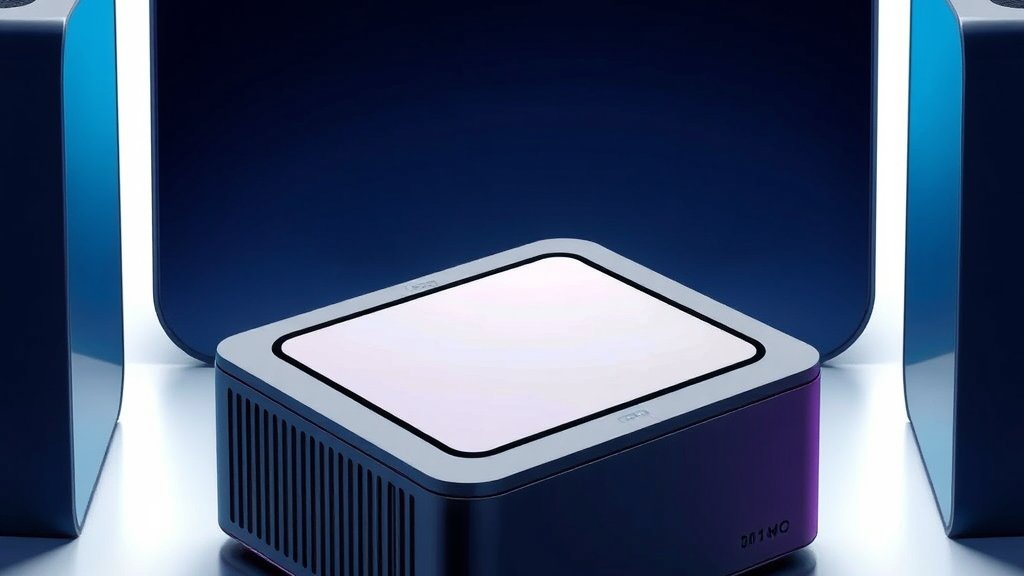
Somewhere in China, a small company is making a large claim. Its mini PC, the company says, performs like a bigger machine. We do not know the company's name. We do not know the product's name. We do not know the benchmark, the comparison model, the price, the release date or the ports.
That is not a failure of reporting on my part. It is the shape of the story as it reached me: a claim without a citation, a product without a spec sheet, a challenger without an address. Which makes it a useful case study, because most performance claims arrive in roughly this condition. The marketing chart comes first. The evidence, if it comes at all, arrives later and quieter.
Mini PCs are an odd category to make bold claims in. They are small by definition, and smallness is a thermal problem before it is anything else. A processor that shines in a thirty-second burst can wilt in a ten-minute export. So "rivals larger machines" is not one claim but several, and the interesting question is which one is being made.
The honest position is that this claim is unverified. No independent lab has published results, no reviewer has tested a retail unit, and the brief that prompted this article names no benchmark, no score and no comparison machine. What follows is therefore a guide to the claim rather than a verdict on the product. It is about what would have to be true, and what you would need to see, before the sentence "rivals larger machines" deserves your attention.
The Startup We Cannot Quite Name
Start with the most basic problem. A performance claim is only checkable if you can trace it to a document. A press release, a spec sheet, a product page, a recorded demo, a filing. The claim in this case cannot be traced to any of those, because the company and the product are not identified in the material available.
That matters more than it sounds. Naming the company lets you check its history: has it shipped hardware before, does it have a support page, does it answer warranty emails. Naming the product lets you find its manual, its firmware downloads, its list of ports. Without either name, a reader cannot confirm that the product exists in a form anyone can buy.
The dossier behind this article is explicit about its own limits. It was assembled without a search being run, and it describes its contents as unverified background. Every entry in it reads the same way: the question is stated, and the answer is a placeholder. Which startup? Unknown. Which product? Unknown. Which benchmark? Unknown.
This is worth saying plainly because the technology press is full of claims that arrive in exactly this state. A company issues a teaser, a chart circulates, and the chart is repeated until it feels like a fact. The repetition is the only thing that changed. Nobody measured anything.
So the first thing to establish about this claim is what kind of object it is. It is an assertion, not a result. It has no attached methodology, no named test, no comparison figure and no date. It may well turn out to be true. But at the moment it is a sentence, and sentences are cheap.
There is a second, subtler problem with an unnamed product. Even a bad benchmark is useful, because you can argue with it. You can look at the settings, the power limit, the cooling, the BIOS version, and decide whether the number means anything. An unnamed product gives you nothing to argue with. It gives you a mood.
The practical consequence is that a buyer cannot yet act on this claim at all. You cannot pre-order a product you cannot name. You cannot compare it to a machine you already own. You cannot check whether the warranty is one year or three. The claim exists in a kind of limbo, vivid enough to be repeated and too thin to be tested.
- No company name, so no shipping history to check.
- No product name, so no manual, firmware page or port list.
- No benchmark named, so no score to compare.
- No comparison machine named, so no baseline.
- No price, release date or warranty terms.
- No reviewer, lab or retail unit test on record.
What "Rivals Larger Machines" Actually Says
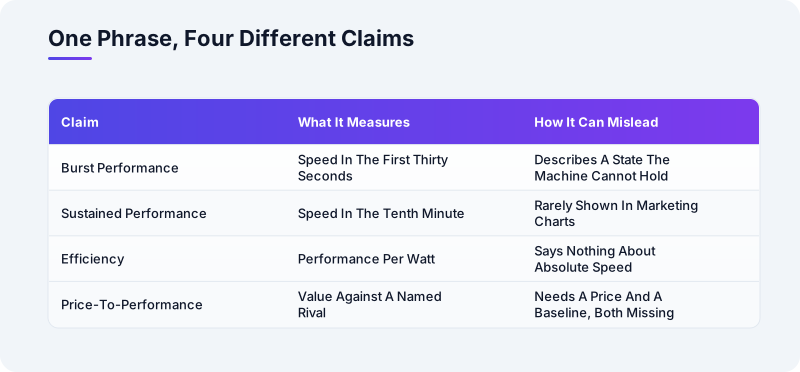
The phrase sounds like a single claim. It is at least four, and they fail in different ways. The first is burst performance: how fast the machine is for the first thirty seconds of a task. The second is sustained performance: how fast it is in the tenth minute, once the heatsink has soaked up heat. The third is efficiency, meaning performance per watt. The fourth is a price-to-performance ratio, which is a claim about money rather than silicon.
A mini PC can genuinely win the first and lose the second. Small cases hold small heatsinks, and small heatsinks saturate quickly. A chip that boosts to a high clock for a short run will throttle once the thermal budget is spent. So a chart captured in the first minute can be honest and still misleading, because it describes a state the machine cannot hold.
"Larger machines" is equally slippery. A tower with a discrete graphics card is a different class of computer from a mini PC with integrated graphics. Beating a five-year-old desktop is a modest achievement in 2024 terms. Beating a current tower at the same price is a real one. The claim does not say which comparison it means, and the difference between those two readings is the whole argument.
There is also the question of workload. A mini PC with a strong processor and integrated graphics can be excellent at compiling code, running a spreadsheet model or transcoding a video. It can be mediocre at a modern game, because games lean on the graphics card. "Strong performance" without a workload is like saying a car is fast without saying on what road.
The dossier lists the missing pieces in exactly these terms. It asks which benchmark, which comparison machine and what score, and records no answer for any of them. It asks whether the claim refers to the processor, the graphics or the whole system, and again records nothing. Those are not small gaps. They are the claim.
This is where the analogy of the small car starts to break. A small car's top speed is a single number you can look up. A computer's speed depends on the task, the duration, the cooling and the power limit. The same machine can look fast in one review and slow in another without either reviewer lying.
- Burst speed versus sustained speed.
- Processor, graphics or whole-system performance.
- Which larger machine, at which price, from which year.
- Which workload, since games and code stress different parts.
- Whether the comparison machine was tested on the same bench.
The Hardware You Would Want To See First
Before any benchmark matters, you need the parts list. For a mini PC the essential entries are the processor model and its exact variant, the graphics, the amount and type of memory, the storage interface, and the thermal design power configuration. That last one is the setting that decides how much heat the chip is allowed to produce, and it is often the difference between two machines with the same processor.
Processor names hide this. Two laptops or mini PCs can carry the same model number and run at different power limits, because the manufacturer chooses the limit. A higher limit means more performance and more heat. A lower limit means a quieter, cooler machine that scores lower. Neither is cheating. But a benchmark without the limit stated cannot be compared to anything.
Memory matters in a quieter way. Capacity is easy to state; speed and channel count are the ones that change results. Two memory modules running in dual-channel mode can move data faster than a single module of the same total size. A spec sheet that says "16GB" and stops there has told you less than half the story.
Storage is the third gap. The interface matters, since a fast drive and a slow drive feel different in everyday use even when the processor is identical. The dossier asks for the storage interface and records no answer. It also asks for the processor and graphics variants, memory type, speed and capacity, and the thermal design power, and records nothing for any of them.
Then there is the physical side. Dimensions, port layout, fan behaviour and noise are not performance figures, but they decide whether a machine is pleasant to live with. The dossier lists ports and dimensions among the undisclosed details, alongside price, release date and warranty. A mini PC without a port list is a photograph, not a product.
None of this is exotic. Every established mini PC maker publishes a spec sheet with these fields, because buyers ask. The absence here is not proof of anything sinister. It is simply the state of an early claim, and it is the reason the claim cannot yet be checked.
- Processor model and exact variant.
- Graphics, integrated or discrete.
- Memory capacity, type, speed and channel count.
- Storage interface and drive model.
- Thermal design power and any configurable limit.
- Ports, dimensions, noise and warranty terms.
How A Serious Performance Claim Is Built
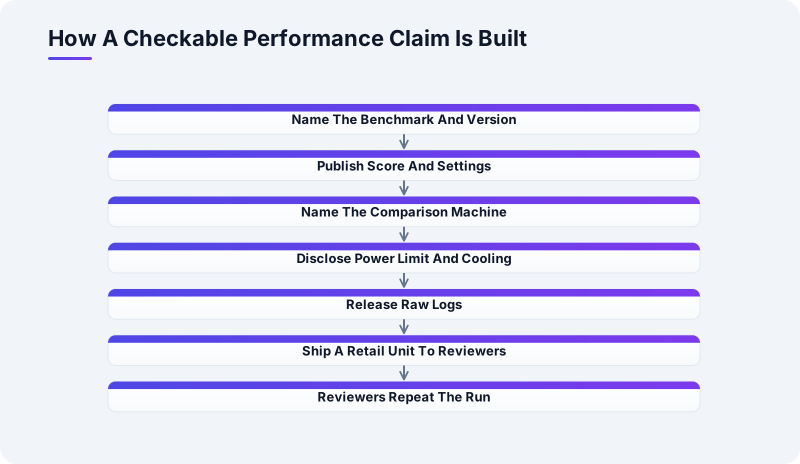
The industry has a rough template for this, and it is not complicated. A maker runs a named benchmark, such as Cinebench for processor work, 3DMark for graphics or PCMark for mixed office tasks. It publishes the score, the version of the test, the settings used, and the machine it is being compared against. Then it lets reviewers repeat the run.
The repeat is the important part. A benchmark is only meaningful if someone else can get the same number on a machine they bought themselves. That is why reviewers insist on retail units rather than vendor-supplied samples. A hand-picked sample can be binned, meaning selected for good behaviour, and a retail unit cannot.
Conditions belong in the same document. Ambient temperature changes results, because a chip in a warm room throttles sooner. Whether the run was a single pass or a ten-minute loop changes results, because the loop exposes sustained behaviour. The BIOS version matters too, since firmware can alter power limits. A score without those details is a number in a vacuum.
The dossier sets out this bar clearly. It lists reproducible benchmark runs with disclosed settings, power limits and cooling conditions as the normal standard. It lists full specifications as the other half. It then notes that without disclosed methodology, even published numbers cannot be fairly compared. That is the test this claim has not yet met.
There is a lower bar that still counts for something. A company can publish raw logs or screenshots with the system information visible on screen. That is not as good as an independent review, but it is far better than a bar chart with no axis labels. It shows the test was run on real hardware and lets others try to reproduce it.
What the claim offers instead, so far, is a conclusion without a method. The honest caveat is that this may change. A company can release a spec sheet tomorrow and a reviewer can test a retail unit next month. Until then, the claim sits in the category of things that might be true.
- A named benchmark and its version.
- The score, plus the settings used.
- The comparison machine, named and tested the same way.
- Ambient temperature and cooling conditions.
- Single pass or sustained loop.
- BIOS version and power limit.
- Raw logs with system information visible.
- A retail unit in a reviewer's hands.
The Details Still Missing In The Dark
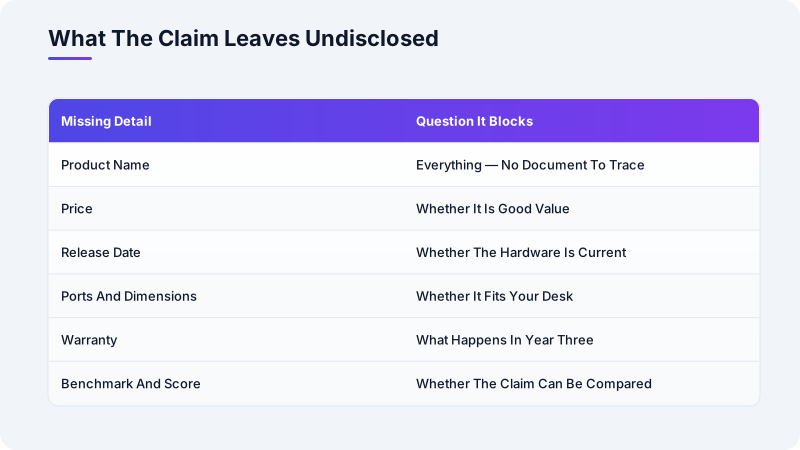
It is worth listing what remains undisclosed, because the list is long and each item blocks a different question. The product name is missing, which blocks everything. The price is missing, which blocks the value argument entirely. The release date is missing, which blocks any judgement about whether the hardware is current.
The ports and dimensions are missing, which blocks the everyday question of whether it fits your desk and your monitor. The warranty is missing, which blocks the question of what happens in year three. The dossier names each of these as undisclosed, and adds the deeper ones: which benchmark, which comparison machine, what score, and whether the claim concerns the processor, the graphics or the whole system.
There is also the question of test conditions, which the dossier raises and leaves open. Cooling, power limits, ambient temperature, sustained versus burst. Each of these can swing a result enough to change the story. A claim that omits all four is not hiding a number so much as declining to have one.
The absence of third-party coverage is the other gap. The dossier asks whether any independent reviewer or lab has tested the machine, and whether retail units were used, and records no answer. That is not the same as saying no review exists. It means none is cited in the material available, which is a different and narrower statement.
This is where skepticism should be calm rather than theatrical. A young company with a new product often has no reviews yet, because reviewers need units and units need a launch. The gap is normal. What is not normal is asking buyers to accept a performance claim while the gaps remain open.
The fair summary is that the claim is interesting and unevidenced. It might describe a genuinely efficient design, a clever thermal solution, or simply a well-chosen benchmark. It might describe none of those. The point is that a reader cannot yet tell, and the company has not given them the means.
- Product name, price and release date.
- Ports, dimensions and warranty.
- Benchmark, score and comparison machine.
- Processor, graphics or system-level claim.
- Cooling, power limit and ambient conditions.
- Sustained versus burst behaviour.
- Any independent review of a retail unit.
A Buyer's Checklist Before Believing It
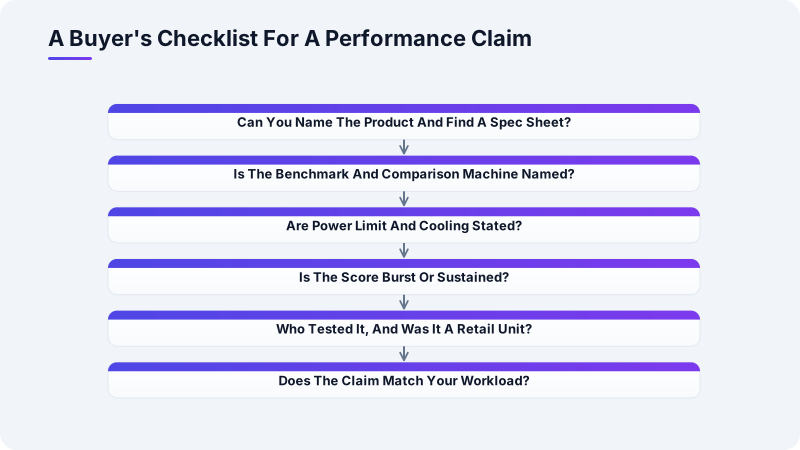
If a claim like this reaches you again, the response is a short sequence of questions rather than a verdict. First, can you name the product and find a spec sheet? If not, stop there. A claim you cannot attach to a document is not yet information.
Second, is the benchmark named, and is the comparison machine named? A chart that says "up to 40 percent faster" without saying faster than what is not a comparison. It is an adjective with a number attached. The number does not rescue the missing baseline.
Third, are the conditions stated? Look for the power limit, the cooling setup and whether the run was a single pass or a loop. If a maker reports a burst score and calls it performance, ask what the score looks like after ten minutes. That single question separates a demo from a product.
Fourth, who tested it? A review of a retail unit bought at normal retail is the strongest signal. A review of a vendor sample is weaker but still useful. A first-party chart is the weakest of the three, and should be treated as a hypothesis rather than a result.
Fifth, does the claim match your workload? A machine that compiles code quickly may still disappoint in games, and the reverse is also true. Match the claim to the task you actually do, and ignore the rest of the chart. This is the step most buyers skip.
The dossier's own guidance points the same way. It recommends asking for raw logs or screenshots with system information visible, rather than marketing charts. It notes that independent reviews of retail units are a stronger signal than first-party claims. That is the whole method, and it fits on an index card.
- Name the product and find the spec sheet.
- Name the benchmark and the comparison machine.
- Check the power limit and cooling conditions.
- Ask whether the score is burst or sustained.
- Prefer retail-unit reviews to vendor samples.
- Match the claim to your own workload.
The Takeaway Worth Trying
The next time a mini PC maker, or any hardware maker, claims its machine rivals something larger, do one specific thing before you read further. Open the product page and search it for the words "power limit" or "TDP". If the figure is there, note it, then look for the benchmark's settings and the name of the comparison machine. If any of those three is missing, treat the claim as a hypothesis and wait for a review of a retail unit.
It takes about two minutes, and it will save you from repeating a chart that nobody measured.