The Autopilot: The Co-Pilot That Rarely Sleeps
Ask a nervous flyer what an autopilot does, and you will probably get one of two answers. The first is that it flies the plane from takeoff to landing while the pilots read newspapers. The second is that it does nothing of the sort and is basically a fancy cruise control for the sky. Both answers are wrong. The real story is more interesting, more precise, and involves a system that has quietly become one of the most reliable crew members in the cockpit.
Most passengers board a plane thinking about seatbelts and snack service, not gyroscopes and servos. Yet between the time the wheels leave the ground and the moment they touch down again, a silent loop of sensing, comparing and correcting runs hundreds of times per minute. The autopilot is not a pilot. It is a tireless machine that keeps a set of numbers where the crew wants them.
The system is old enough to be boring. The first practical autopilot, invented by Lawrence Sperry in 1914, used a gyroscope to keep wings level and allowed a pilot to walk away from the controls entirely. Today's versions manage entire flights, integrate with satellite navigation, and communicate with air traffic control through the flight management system. But the core idea has not changed: measure, compare, correct.
The Name Does Not Mean What You Think
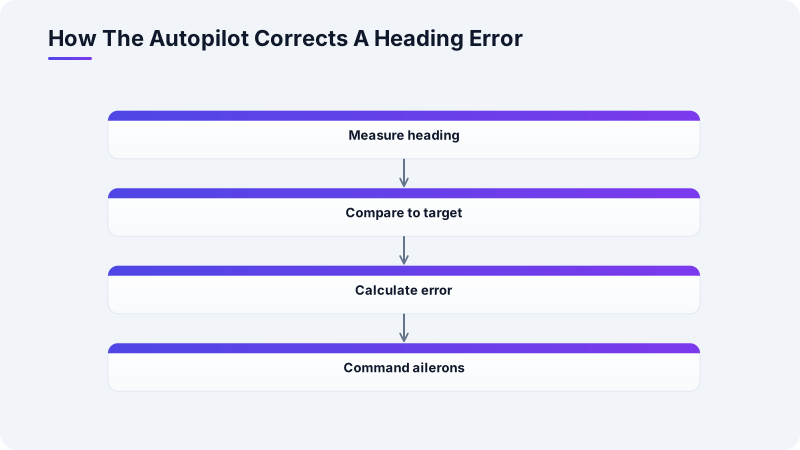
The word "autopilot" suggests a system that flies by itself. In practice, it is more like a robot that follows very detailed instructions from a human. The pilot does not say "fly to New York." The pilot enters a heading, an altitude, a vertical speed, or a navigation waypoint. The autopilot then calculates the difference between where the plane is and where the pilot wants it to be. That difference is called an error, and the autopilot lives to make errors disappear.
Sensors do the measuring. Gyroscopes track the aircraft's orientation in all three axes. Accelerometers sense changes in speed and direction. GPS satellites provide position down to a few meters. The autopilot compares these readings to the desired values set by the pilot or the flight management system. If the heading drifts two degrees right of the target, the autopilot sends a command to the ailerons to roll slightly left and bring the nose back.
The SKYbrary reference notes that autopilots are classified by how many axes they control. A single-axis system controls only roll. A two-axis system adds pitch. A three-axis system controls roll, pitch and yaw, which means it manages the entire orientation of the plane. Most commercial aircraft use three-axis systems, but even a cheap single-axis unit can keep a small plane level while the pilot reaches for a chart.
The Vending Machine That Follows Its Own Receipts
Think of the autopilot as a vending machine for command. You press a button for altitude hold, and the system locks onto the current altitude as if the plane has latched onto an invisible rail. But unlike a vending machine, which simply drops a bag of chips, the autopilot constantly checks whether it is still on the rail. It reads the barometric altimeter at least once per second. It compares the reading to the target. It adjusts the elevator trim to prevent altitude drift.
The FAA Airplane Flying Handbook describes specific modes that make this possible. Heading hold keeps the nose pointing at a compass number. Altitude hold keeps the plane at a set pressure altitude. Vertical speed hold maintains a constant rate of climb or descent. Navigation mode follows a radio beacon or a GPS course, which is how an aircraft can fly a 300-nautical-mile airway with corrections measured in fractions of a degree.
The key detail is that the pilot sets these modes. The autopilot does not decide when to climb or turn. It executes the plan the pilot enters into the flight management system. If the plan changes, the pilot disengages the autopilot, makes the adjustment, and re-engages it. A modern flight deck is a constant conversation between human intention and machine execution.
The Smooth Operator That Saves Fuel
A human pilot can hold a heading to within a few degrees. A tired human pilot after four hours of cruising can drift more. The autopilot holds heading to within a fraction of a degree for as long as its power stays on. That precision translates directly into fuel savings. Simple Flying notes that modern autopilots integrated with the flight management system can compute optimal climb profiles, cruise altitudes and descent paths for the weight of the aircraft and the wind conditions.
The result is that the autopilot often flies more efficiently than a human would. It makes smaller, more frequent corrections rather than large, infrequent ones. It follows a smooth arc rather than a zigzag. An airline flying hundreds of flights a day saves thousands of tons of fuel each year through automated navigation, which also reduces carbon emissions.
But efficiency comes with a catch. The autopilot is only as smart as the data it receives. If a wind forecast is wrong, the autopilot cannot second-guess it. If a navigation database has an error, the autopilot will route the plane straight through a restricted airspace zone. The system needs periodic updates and constant supervision, which is why pilots train to monitor it even when it is doing everything right.
The Hands-Off Moment That Still Requires Hands
Takeoff and landing are the moments that attract the most attention, and for good reason. These phases of flight involve the most variables, the lowest altitude margins, and the highest pilot workload. The FAA handbook is explicit: autopilots can assist during takeoff and landing, but the pilot must supervise. Most commercial aircraft do not use autopilot during takeoff at all. Landing is more complex.
Some aircraft, like the Boeing 777 and Airbus A350, can perform automatic landings in low visibility conditions. The autopilot receives guidance from the Instrument Landing System (ILS), which broadcasts a precise radio beam from the runway. The autopilot aligns the airplane with the beam and flares just above the runway to touch down smoothly. This is called a Category III approach, and it requires certified equipment and specially trained crews.
Even then, the pilot keeps hands near the controls. The disconnect switch is always within reach. If the autopilot makes an unexpected maneuver, a sharp pull on the yoke or a push of a red button disengages it instantly. The system has fail-safes like automatic disengagement during extreme bank angles or pitch attitudes. The machine is trusted, but trust is audited every second.
The Awkward Bits They Do Not Advertise
The honest caveat is that autopilots can and do confuse themselves. Every few years, an accident report describes a situation where the autopilot flew the aircraft into terrain or stalled the wings because its sensors received conflicting data. The 2009 crash of Air France Flight 447 is a sobering example. Ice blocked the pitot tubes, which measure airspeed. Without reliable speed data, the autopilot disconnected, and the pilots faced a confusing situation they were not prepared to handle.
The problem is not that autopilots are unreliable. The problem is that pilots can become reliant on them. When the autopilot disengages unexpectedly, the human brain needs time to reorient itself. That time cost, measured in seconds, can be fatal at low altitude or in poor weather. Training now emphasizes manual flying practice and partial-panel scenarios, where pilots fly without autopilot or flight director guidance.
Another awkward truth is that autopilots are terrible at handling emergencies. They cannot diagnose an engine failure or decide whether to divert to an alternate airport. They simply follow the last valid instructions. In a crisis, the most capable machine in the cockpit is still the one with a heartbeat.
Wrapping Up, Softly
The autopilot is not a replacement for a pilot. It is a tool that lets pilots spend their attention where it matters most. A human can monitor a dozen instruments for ten hours, but the autopilot monitors them without blinking. The pilot watches for the thing that does not appear in any manual: a bird strike, a sick passenger, a weather decision that a machine cannot make. The two have been working together for over a century now. They are not partners, exactly.
They are more like a careful driver and a very good cruise control that listens. The best part of the arrangement is that the machine never whispers its opinion.