The Hidden Cost Of Context Switching: How Multitasking Sabotages Your List
It is 10:14 a.m., and you have opened the document you meant to finish by noon. A message arrives. It is not urgent, but the notification is already in...

It is 10:14 a.m., and you have opened the document you meant to finish by noon. A message arrives. It is not urgent, but the notification is already in your eyeline. You read it, reply, and return to the document. The cursor blinks in the same spot, yet the thought you were holding is gone. The document is still open, but the work has stopped.
This is not a failure of discipline. It is a structural feature of knowledge work, where the tools you need are the same tools that interrupt you. The inbox, the chat channel and the calendar are not separate from the work. They are the work's plumbing, and they leak. What gets lost in the leak is not just time - it is the internal narrative that turns a collection of sentences into an argument, or a set of requirements into a design.
The term for what you just lost is context switching, and its cost is larger than most workplaces acknowledge. When you move your attention from one task to another, you do not simply pause the first task. You leave a piece of your mind on it, and that piece takes time to retrieve. The result is a working day that feels full but produces less than a quieter day would, and a list that keeps growing while you answer messages about the list.
Understanding the mechanism does not make the interruptions stop. But it does change what you blame - and what you protect. The cost is real, measurable and unevenly distributed. Some people pay it more heavily than others, not because they are worse at their jobs but because their jobs demand more of the cognitive resource that switching destroys.
The 23-minute Tax You Pay Without Knowing It
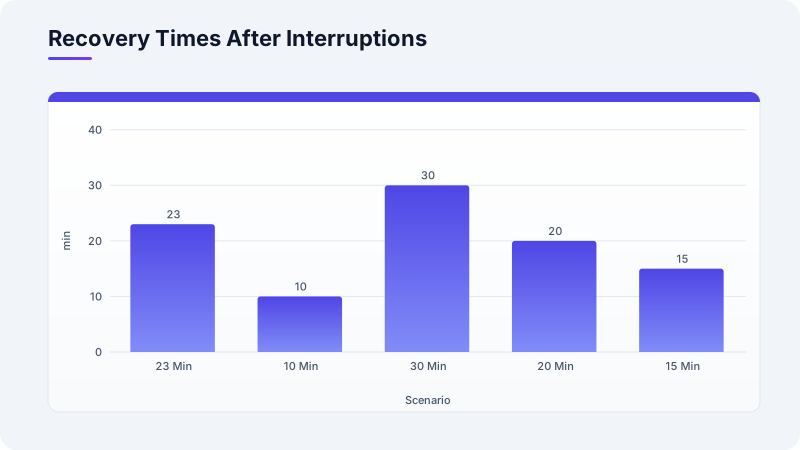
In 2005, researchers at the University of California, Irvine, measured something that still shapes how we should think about interruptions. They observed workers in their actual offices and found that after an interruption, it took an average of 23 minutes and 15 seconds to return to the original task. The number is specific enough to be useful and old enough to have been absorbed into workplace folklore. But its meaning is often misunderstood.
The 23 minutes is not the length of the interruption. It is the recovery time after the interruption ends. The quick check of a message may take 30 seconds. The cognitive cost is what happens next: the mental reassembly of where you were, what you had decided and what you were about to do. For a task that requires holding several pieces of information in mind at once - a budget, a client's constraint, a technical limitation - the reassembly is not a luxury.
It is the work itself.
Gloria Mark, a researcher at the University of California, Irvine, whose 2016 work on interrupted work is among the most cited in the field, found that the average knowledge worker switches tasks every 10.5 minutes. If the recovery time is even half the 23-minute figure, the arithmetic is punishing. A worker who switches every 10 minutes and needs 10 minutes to refocus is spending half the day in a state of partial attention.
The other half is spent on the shallow surface of tasks, never reaching the layer where difficult thinking happens.
The 23-minute figure comes from a specific study of specific workers, and it is not a universal law. Your own recovery time depends on the complexity of the task you left and the depth of the interruption. A quick question about lunch plans costs less than a request to redo a calculation. But the mechanism is the same: attention is not a light switch. It is more like a stove burner that takes time to cool down and heat up again.
The switch itself is fast; the temperature change is slow.
What makes the tax invisible is that it is paid in small increments nobody tracks. A timesheet records hours on a project, not the minutes lost to reorientation. A manager sees that the document was finished, not that it took twice as long as it should have. The worker feels the drag - the sense of a day that slipped away - but cannot point to a single cause.
The cause is the accumulation of tiny recovery periods, each one too small to notice and too frequent to ignore.
Attention Residue: The Thought You Cannot Leave Behind
Sophie Leroy, a researcher at the University of Washington Bothell, gave the mechanism a name in 2009: attention residue. Her work showed that when people switch from Task A to Task B, a part of their attention stays with Task A. The residue is not a metaphor. It is a measurable impairment: people perform worse on Task B while their mind is still partially occupied with Task A, and the effect is stronger when Task A is unfinished or cognitively demanding.
The implication is uncomfortable because it contradicts how most offices organise work. The standard advice is to leave a difficult task and return to it later with fresh eyes. But Leroy's research suggests that leaving a task unfinished does not free your mind. It occupies it. The unfinished task becomes a background process, consuming cognitive resources while you try to focus on something else. The break that was supposed to refresh you has instead split your attention.
This is why the open-plan office, with its promise of collaboration and serendipity, can be a machine for generating attention residue. A colleague stops by to ask a question. The question is about a project you were working on yesterday. You answer it, but the conversation reactivates the mental model of that project, and now you are carrying two projects in your head while trying to work on a third. None of them gets your full attention, and all of them take longer.
The effect is not limited to interruptions from other people. Self-interruption - the voluntary check of email or a news site - produces the same residue. The difference is that self-interruption feels like a choice, which makes it harder to recognise as a cost. But the cognitive mechanism does not care whether the switch was voluntary or imposed. The residue is the same.
Leroy's work suggests that the only way to clear the residue is to reach a natural stopping point on the task before switching, a luxury that most workdays do not afford.
The practical consequence is that a day spent juggling several complex tasks is not a day of high output. It is a day of high switching cost. Each task leaves a residue that impairs the next, and by the afternoon the worker is operating at a fraction of their capacity. The list looks the same length it did in the morning, but the quality of thought applied to it has degraded. The residue has become the work's invisible friction.
Why Your List Keeps Winning
The to-do list is the most honest document in the office. It records what you intended to do, not what you did. At the end of a day of constant switching, the list is often longer than it was in the morning. New tasks have arrived, old ones have been partially completed, and the satisfaction of crossing something off is outweighed by the frustration of seeing the queue grow. The list is not failing you.
The interruptions are, and the list is simply recording their effect.
The mechanism is a queueing problem disguised as a productivity problem. Every interruption is a new arrival that jumps the queue. The task you were working on moves to the back of your mental line, and when you return to it, you pay the reorientation cost. Meanwhile, the interruption itself generates new tasks: the reply that requires a follow-up, the question that spawns a meeting, the quick fix that reveals a deeper issue. The list grows because each interruption is not a single item.
It is a seed that produces more items.
The part of the list that suffers most is the deep work - the writing, the analysis, the design - that requires sustained attention. These tasks are the ones most vulnerable to context switching because they depend on a mental model that takes time to build and is easily dismantled. A 30-minute interruption in the middle of a three-hour writing block does not cost 30 minutes. It costs the 23-minute recovery time plus the time it takes to rebuild the argument you had constructed.
The cost is closer to an hour, and the writing block is now too short to be useful.
The shallow tasks - the replies, the approvals, the status checks - are less affected by switching because they do not require a deep mental model. They can be done in short bursts, and the recovery cost is low. The danger is that the shallow tasks multiply to fill the available time, and the deep tasks are perpetually deferred. The list becomes a record of shallow work completed and deep work postponed, and the worker ends the week feeling busy but unsatisfied.
The list itself is not the problem. The problem is that the list does not distinguish between tasks that can survive interruption and tasks that cannot. A task that says "reply to client email" can be done in five minutes between meetings. A task that says "draft project proposal" cannot. When the day is structured as a series of interruptions, the proposal never gets the sustained attention it needs, and the list becomes a monument to good intentions.
The 2% Who Get A Pass, And What They Cost The Rest
A 2013 study from the University of Utah found something that should give pause to anyone who believes they are good at multitasking. The researchers tested participants on a simulated driving task while also asking them to perform a memory task. Only 2% of the participants showed no performance degradation when multitasking. The other 98% got worse, and most of them did not realise it.
The finding is important because it challenges the self-assessment most people make about their own multitasking ability. The belief that you are the exception is widespread and almost always wrong. The study suggests that the people who are most confident in their multitasking are often the ones whose performance suffers most. The confidence is not evidence of ability. It is evidence of a blind spot.
The 2% figure is a laboratory finding, not a workplace measurement, and it comes with the usual caveats about generalising from a controlled experiment to a real office. But the direction of the finding is consistent with other research. The 2009 Stanford study found that heavy media multitaskers performed worse on cognitive control tasks than light multitaskers. They were more easily distracted by irrelevant information and less able to switch between tasks efficiently.
The very people who spent the most time multitasking were the least equipped to do it well.
The cost of the 98%'s performance degradation is not borne equally. In a team, the person who is interrupted most is often the person whose work is least visible - the analyst rebuilding a model, the writer structuring an argument, the designer iterating on a layout. Their output is measured in quality, not volume, and the degradation shows up as a subtle decline in thoroughness or originality.
The manager who interrupts them may not see the cost because the cost is in what was not produced, not in what was.
The 2% finding also has a darker implication for how work is organised. If only a tiny fraction of people can multitask effectively, then a workplace designed around constant switching is optimised for almost nobody. The open-plan office, the always-on chat channel and the expectation of immediate response are built on an assumption about human cognition that the evidence does not support. The design is for a species of worker that barely exists.
The Developer's 40% And The Manager's Paradox
Context switching does not affect all professions equally. Software developers are among the most studied group, and the numbers are stark. A 2021 working paper from the National Bureau of Economic Research, authored by researchers including Michael Gibbs and Friederike Mengel, found that context switching can consume 20% to 40% of a developer's effective time. The range is wide because the cost depends on the complexity of the code and the depth of the interruption.
A developer who is deep in a debugging session is holding a mental model of the code's structure, the data flow and the possible sources of the bug. An interruption - a question from a colleague, a meeting notification, a Slack message - dismantles that model. Rebuilding it can take 15 to 30 minutes, and if the interruption occurs several times a day, the developer may spend more time rebuilding models than writing code.
The 40% figure is not an exaggeration for the most complex work. It is a description of a day spent context switching.
Managers face a different version of the same problem. Their work is inherently fragmented: a day of meetings, decisions and quick responses. The cost of context switching for a manager is not measured in lost coding time but in degraded decision quality. A manager who makes a budgeting decision immediately after a personnel issue is carrying attention residue from the personnel conversation.
The budgeting decision may be made with less care, not because the manager is negligent but because the cognitive resources are still partially occupied.
The paradox is that the manager's fragmented day often creates the interruptions that fragment the developer's day. The manager, whose work is designed for switching, imposes switching on the people whose work is not. The manager asks a quick question, unaware that the question will cost the developer 20 minutes of recovery time. The asymmetry of the cost is invisible to both parties: the manager sees a 30-second interaction, and the developer feels an afternoon that slipped away.
The solution is not for managers to stop asking questions. It is to recognise that the question has a cost and to batch the interruptions. A single daily check-in that addresses several questions costs less than four interruptions spread across the day because the recovery cost is paid once, not four times. The batching is a structural change that respects the different cognitive demands of different roles, and it costs the manager almost nothing.
Cortisol, Gray Matter And The Body's Invoice
The cost of context switching is not only cognitive. It is physiological. Multitasking increases the production of cortisol, the hormone associated with stress, and adrenaline, which prepares the body for action. The combination is useful for short-term threats - the proverbial sabre-toothed tiger - but toxic when sustained over a working day. The body is designed for bursts of stress followed by recovery, not for the low-grade, continuous stress of a day spent switching tasks.
A 2018 study from the University of Sussex found an association between frequent media multitasking and lower gray matter density in the anterior cingulate cortex, a brain region involved in cognitive control and emotional regulation. The study is correlational, not causal: it does not prove that multitasking causes the structural change, only that the two are linked. But the direction of the link is consistent with the cognitive findings.
The people who multitask most show differences in the brain regions that would help them resist multitasking.
The cortisol effect is more immediately relevant to the working day. Elevated cortisol over time is associated with impaired memory, reduced immune function and increased risk of burnout. The worker who ends the day feeling exhausted but not productive is experiencing the physiological signature of context switching. The exhaustion is not from the volume of work but from the cost of switching, which the body registers as stress even when the tasks themselves are not stressful.
The physiological cost is also a fairness issue. If context switching is distributed unevenly - if some roles are interrupted constantly while others are protected - then the stress is distributed unevenly too. The junior employee who is expected to be responsive to every message may pay a higher physiological price than the senior leader whose calendar is managed by an assistant. The cost is not just in productivity. It is in health, and it accrues over years.
The body's invoice arrives whether or not the worker acknowledges the cost. The afternoon headache, the evening irritability, the sense of being wired and tired at the same time - these are not signs of a busy week. They are signs of a cognitive system that has been switching too often and recovering too little. The list is not the only thing that suffers. The body does too.
What People Try First, And Why It Usually Fails
The most common response to the cost of context switching is to try harder. The worker who notices the drag resolves to be more disciplined: to check email only at set times, to turn off notifications, to block time on the calendar for deep work. The resolution is sincere, and it usually fails within a week. The failure is not a character flaw. It is a structural problem disguised as a personal one.
The structural problem is that the interruptions are not random. They are embedded in the design of the work. The manager who expects a quick response, the client who calls without warning, the colleague who stops by the desk - these are not distractions to be ignored. They are the work's legitimate demands, and ignoring them has consequences. The worker who turns off notifications may miss a decision that affects their project.
The discipline strategy fails because it treats a systemic problem as an individual one.
Another common response is the "two-minute rule": if a task takes less than two minutes, do it immediately. The rule is appealing because it feels productive. But it guarantees constant switching. Every two-minute task is an interruption, and the recovery cost is paid after each one. The rule works only if the two-minute tasks are genuinely rare, which in most knowledge-work jobs they are not. The inbox is a queue that never empties, and the two-minute rule turns the worker into the queue's servant.
Time-blocking - reserving large chunks of the calendar for focused work - is more effective but harder to sustain. It requires organisational permission: the manager who sees an empty calendar slot may fill it with a meeting, and the colleague who sees a "busy" block may interpret it as flexible. The block is only as protected as the culture around it, and in many workplaces the culture does not protect it at all.
The worker who time-blocks without changing the expectations around responsiveness is setting a boundary that others will cross.
The failure of individual strategies points to a larger truth: context switching is an organisational problem that individual workers are asked to solve. The worker can control their own behaviour, but they cannot control the behaviour of everyone who interrupts them. The solution that sticks is not a personal productivity hack. It is a collective agreement about when interruptions are allowed and when they are not, and that agreement requires a conversation most teams never have.
The Meeting That Outlives Its Own Decision
The status meeting is the most expensive context switch in the knowledge worker's week. A half-hour meeting with eight people is not half an hour of organisational time. It is four person-hours, plus the recovery time for each person who was deep in something else when the meeting started. If each of the eight people loses 15 minutes of focus on either side of the meeting, the total cost is closer to six person-hours.
The meeting may have produced a decision that could have been made in an email.
The status meeting persists because it serves a social function that the email does not. It reassures the manager that work is happening, and it gives the team a sense of shared presence. But the reassurance is expensive, and the presence is often an illusion. The people in the meeting are physically present but cognitively elsewhere, thinking about the work they are not doing. The meeting is a context switch that masquerades as coordination.
The alternative is not to eliminate meetings but to change their shape. A written status update, circulated before the meeting, can replace the round-robin of verbal reports. The meeting itself can then be reserved for the decisions that actually require discussion. The update needs an owner - someone who compiles it and ensures it is read - or it becomes another meeting in written form.
But when it works, it turns a recurring context switch into a one-time read, and the recovery cost is paid once instead of every week.
The meeting that outlives its decision is a special case of the status meeting. It was created to make a specific decision, the decision was made, and the meeting continued anyway. Nobody cancelled it because nobody felt authorised to, or because the calendar invite had become a habit. The meeting is a context switch that no longer has a purpose, and its only function is to interrupt the people who attend it.
Cancelling it is the cheapest productivity gain a team can make, and it requires no new tool or system - only the willingness to look at the calendar and ask what each meeting is actually for.
The deeper question is why the meeting survived its own decision. The answer is usually that nobody owned the decision to end it. The meeting was created by someone who has since moved on, or by a process that nobody remembers. It persists because the cost of the meeting is distributed across the attendees, while the benefit of cancelling it accrues to no single person.
The context switch is a collective problem with no individual owner, and that is why it is so hard to solve.
A Grounded Conclusion
The cost of context switching is not a productivity problem with a productivity solution. It is a design problem: the way work is organised assumes a cognitive architecture that most people do not have. The 23-minute recovery time, the attention residue, the cortisol spike - these are not bugs in the worker. They are features of the human brain, and they do not go away because the office layout or the communication norms demand otherwise.
The list that keeps growing is not a personal failing. It is a signal. It is telling you that the work is structured for switching when it should be structured for focus, and that the solution is not to try harder but to change the structure. The change may be as small as a single cancelled meeting or as large as a team agreement about response times.
But it starts with recognising that the cost is real, that it is unevenly distributed and that the person paying it is often the person least able to change it. That recognition is not an action plan. It is the beginning of a different conversation about what the work actually demands and what it costs.
Sources
- Sophie Leroy, 'Why Is It So Hard to Do My Work? The Challenge of Attention Residue' (2009)
- Gloria Mark, 'The Cost of Interrupted Work: More Speed and Stress' (2016)
- National Bureau of Economic Research, 'The Cost of Context Switching in Software Development' (2021)
- University of Utah, 'The Myth of Multitasking' (2013)
- University of Sussex, 'Media Multitasking and Gray Matter Density' (2018)